
Minority Welfare & Public Policy Research
Equitable resource allocation, scheme accessibility, and data-driven policy reform.
- Status
- ongoing
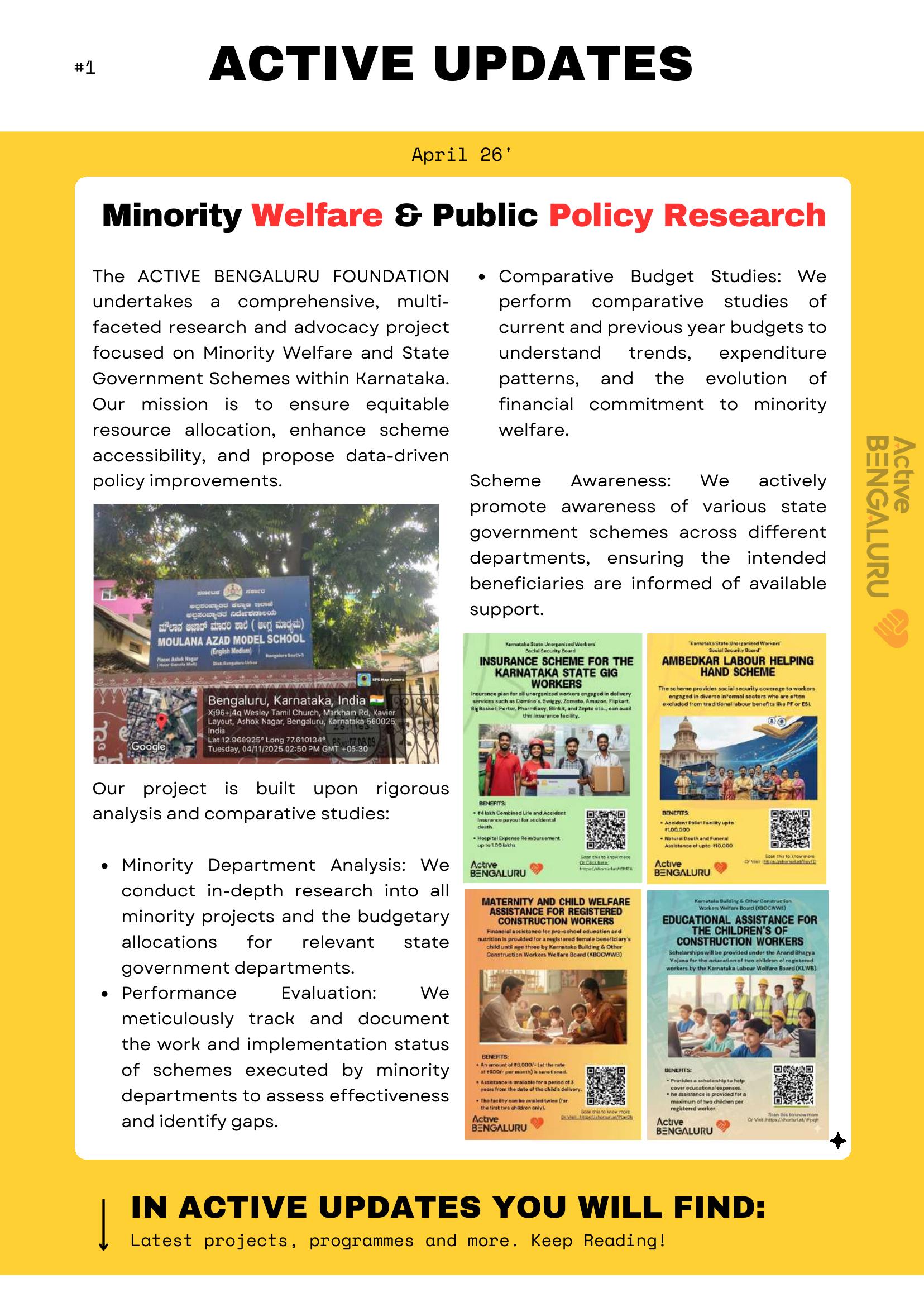
Karnataka has dozens of welfare schemes for unorganised workers, construction labourers, gig workers, women, and minority communities. Most beneficiaries don’t know they exist. ABF’s research and advocacy programme exists to change that.
What we research
Minority Department Analysis — In-depth review of all minority projects and the budgetary allocations for relevant state government departments.
Performance Evaluation — We track and document the implementation status of schemes executed by the minority department, to assess effectiveness and identify gaps.
Comparative Budget Studies — Year-on-year analysis of the State Budget to understand expenditure patterns, trends, and the evolving financial commitment to minority welfare.
Scheme Awareness — Once we have the data, we translate it into accessible explainers — posters, posters in Kannada/Urdu, masjid talks, WhatsApp graphics — so the people the schemes were designed for actually access them.
Schemes we actively promote
- Insurance Scheme for Karnataka State Gig Workers — Karnataka State Unorganised Workers’ Social Security Board
- Ambedkar Labour Helping Hand Scheme — Karnataka State Unorganised Workers’ Social Security Board
- Maternity & Child Welfare Assistance for Registered Construction Workers — KBOCWWB
- Educational Assistance under Anand Bhagya Yojana — KLWB
Advocacy: ABF’s pitch to the State Budget
In February 2024, the ABF team met with the Directorate of Minority, KMDC, KSMC, the Minority Minister, and MLAs at Vidhana Soudha to present a comprehensive set of proposals for the State Budget:
- Nagrik Sahaya Kendra
- Dialysis Sahaya Centre
- Drugs De-addiction Sahaya Centre
- Counselling Sahaya Centre
- NIOS Empanelment
- Community Centres in Bengaluru (Central, North, South)
- Kannada Language Awareness Centre
The ministers were receptive and committed to ensuring minority concerns are integrated into the State Budget.
From Pulpit to Public Health
In January 2025, ABF — along with AIMDC and the Department of Minorities, Government of Karnataka — trained 2,500+ Imams, Mutawallis, and Masjid Committee Members through 13 sessions at Haj Bhavan, Bangalore. The mission: turn religious leaders into health-scheme literacy ambassadors for their congregations.
This is what evidence-based advocacy looks like in practice.